







Reaching out for help with depression is rarely a small decision. By the time most people start searching for a provider for depression, they’ve usually already spent time struggling quietly, wondering if what they’re feeling counts as “bad enough,” or trying to manage it alone.
If that’s the moment you’re in right now, you’re not doing anything wrong by looking for support, and you’re not behind. You’re simply at the point where it makes sense to find people who understand what you’re going through.
This piece looks at what depression treatment actually involves, but more than that, it’s about recognizing what genuine care should feel like, starting with how a provider treats you as a person.
Key Takeaways
- A provider for depression is a specialized clinician or practice focused specifically on diagnosing and treating depressive disorders, not just offering brief check-ins in general primary care.
- Depression has several distinct forms, including major depressive disorder, clinical depression, treatment-resistant depression, and depression within bipolar disorder, and getting the diagnosis right matters for treatment.
- Treatment approaches range from talk therapy and medication management to interventional options like TMS and Spravato® for depression that hasn’t responded to standard treatment.
- A good provider for depression offers real education and resources, not just a checklist, and takes time to understand your story before recommending a treatment plan.
- At Oasis, care starts with a conversation, not a prescription, with compassionate providers across 12 New Jersey locations, free consultations, and support handling insurance every step of the way.
What “Provider for Depression” Actually Means
Search that phrase and you’ll find a mix of things: university research labs studying depression, directory sites listing hundreds of facilities, and actual treatment practices. This piece means the last one, a healthcare practice or department that focuses specifically on diagnosing and treating depressive disorders, rather than addressing mental health as one small part of general primary care.
Even within that, provider setups vary. Some are psychiatrists attached to large hospital systems, working alongside nurses and support staff. Others are specialized outpatient providers focused on delivering specific therapies with depth and consistency. Not every provider works the same way, and that’s worth understanding before you choose one.
What dedicated depression providers have in common is a focus on major depressive disorder and related conditions, specialized training in mental health rather than general medicine, and access to treatment methods beyond what a standard medical checkup can offer. Many providers also evaluate related conditions like anxiety, substance use disorders, and mood disorders such as bipolar disorder, since these often overlap with depression and can complicate diagnosis and treatment if they’re missed.
Understanding Depression: Symptoms and Causes
Depression affects far more than mood. It can affect sleep, appetite, energy, concentration, and a person’s ability to get through daily activities that used to feel manageable. Some of the most common signs include:
- A persistently low, sad, or empty mood that lasts most of the day, most days
- Loss of interest in activities that used to bring enjoyment
- Trouble sleeping, or sleeping far more than usual
- Low energy or fatigue, even after rest
- Difficulty concentrating or making decisions
- Feelings of worthlessness, guilt, or hopelessness
- Changes in appetite or weight
- In more severe cases, thoughts of death or suicide
That last point deserves its own note. If you’re having thoughts of suicide, you deserve support right now, not just information. The 988 Suicide & Crisis Lifeline is available by call or text, 24 hours a day. A good depression provider takes this seriously at every intake, screening for it directly rather than waiting for someone to bring it up on their own.
Depression doesn’t have one single cause. Research points to a combination of genetic, biological, environmental, and psychological factors. Family history can raise a person’s risk, since depression tends to run in families, and ongoing depression research continues to explore the specific genetic factors involved.
Changes in brain chemistry and how certain brain circuits communicate also play a role, which is part of why treatments that work directly on brain function, not just talk therapy or medication, have become an important option for some patients. Life circumstances matter too: major stress, loss, trauma, chronic illness, and hormonal shifts (during postpartum periods or menopause, for example) can all contribute to when and how depression develops, in women and men alike, and at any age.
Types of Depression
There’s more than one kind of depressive disorder, and the differences matter for diagnosis and treatment.
- Major depressive disorder (MDD): the most commonly diagnosed form, involving persistent depressive symptoms that interfere with daily life for at least two weeks, though episodes often last much longer without treatment.
- Clinical depression: a general term often used interchangeably with major depressive disorder to describe depression significant enough to require professional treatment, as opposed to normal, temporary sadness.
- Treatment-resistant depression (TRD): depression that hasn’t improved enough after trying at least two different antidepressant medications, from different drug classes, at adequate doses, for an adequate length of time. It’s a specific clinical designation that affects roughly 1 in 3 people with major depressive disorder, and it’s the point at which more advanced treatment options are usually considered.
- Depression within bipolar disorder: bipolar disorder involves episodes of depression that alternate with episodes of mania or hypomania. Depressive episodes in bipolar disorder can look similar to major depressive disorder on the surface, but they require a different treatment approach, since some standard antidepressants can worsen bipolar symptoms or trigger a manic episode. This is why an accurate diagnosis from an experienced provider, not just a symptom checklist, is such an important first step.
Getting this distinction right is one of the most important things a good evaluation does. A provider who rushes past it, or treats every depressive episode the same way, isn’t doing right by their patients.
Treatment Approaches Used at Centers for Depression
Most providers specializing in depression combine more than one type of treatment rather than relying on just one. Here’s what that typically includes:
- Talk therapy and individual therapy: working one-on-one with a licensed therapist to explore thought patterns, coping tools, and life stressors connected to depression.
- Group therapy and family sessions: some providers offer group-based support, where patients connect with others facing similar struggles, or family sessions that bring loved ones into the treatment process, since depression affects relationships as much as it affects the person experiencing it.
- Medication management: working with a psychiatric provider to find and adjust antidepressant medication, often the first treatment tried for major depressive disorder.
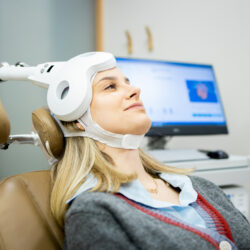
- Interventional psychiatry: for depression that doesn’t respond well enough to therapy and medication alone, treatments like transcranial magnetic stimulation (TMS) and Spravato® (esketamine) work directly on brain function and activity, rather than relying on the same mechanisms as standard antidepressants.
No single approach works for everyone, and that’s exactly why an honest evaluation matters more than a fixed treatment plan decided in advance.
What to Look for When Choosing a Provider for Depression
If you’re trying to evaluate your options, a few questions can help determine whether a depression provider is the right fit for you:
- Does it treat depression specifically, with depth? A center focused on depressive disorders will have more experience recognizing the differences between conditions like MDD, clinical depression, and bipolar depression than a general practice fitting mental health in around everything else.
- Does it offer more than one treatment method? Look for a range that includes therapy, medication management, and, ideally, interventional options for treatment-resistant cases.
- Is the team trained specifically in the treatments offered? TMS and Spravato® both require specific clinical training to administer safely. This isn’t something every psychiatric provider offers.
- How does it handle insurance? A good center will help verify your coverage and manage prior authorization on your behalf, rather than leaving you to navigate that alone.
- What does the first visit actually look like? This is where a lot of centers reveal what they really value.
Our Approach at Oasis: Why Your Story Comes First
Most places hand you a form, ask a set of standard questions, and move straight to a treatment plan. We start somewhere else.
Before we ever talk about a treatment plan, we want to hear your story: what you’ve been going through, what you’ve already tried, what has and hasn’t helped, and where you’re in your life right now. You’re a person, not a set of symptoms to be processed, and the beginning of your care should feel like that.
That first conversation is also where we determine, together, what actually makes sense for you. Sometimes that’s continuing therapy alongside medication. Sometimes it’s exploring whether TMS or Spravato® could help, especially if standard treatment hasn’t gotten you far enough. We’re upfront when something falls outside what we treat here, rather than trying to be everything to everyone.
The depression treatment offered at Oasis centers on major depressive disorder, delivered through TMS and Spravato®, with a psychiatric provider involved in your evaluation, treatment plan, and monitoring throughout, not just administering the treatment itself. Our Paramus location also offers TMS for obsessive compulsive disorder (OCD), and our Millburn location offers ongoing medication management for patients who need it.
With 12 locations across New Jersey, including Cherry Hill, Paramus, Fairfield, Northfield, Turnersville, Millburn, Bridgewater, Forked River, Freehold, Iselin, Princeton, and Tinton Falls, care is meant to be reachable, not something you have to travel hours for.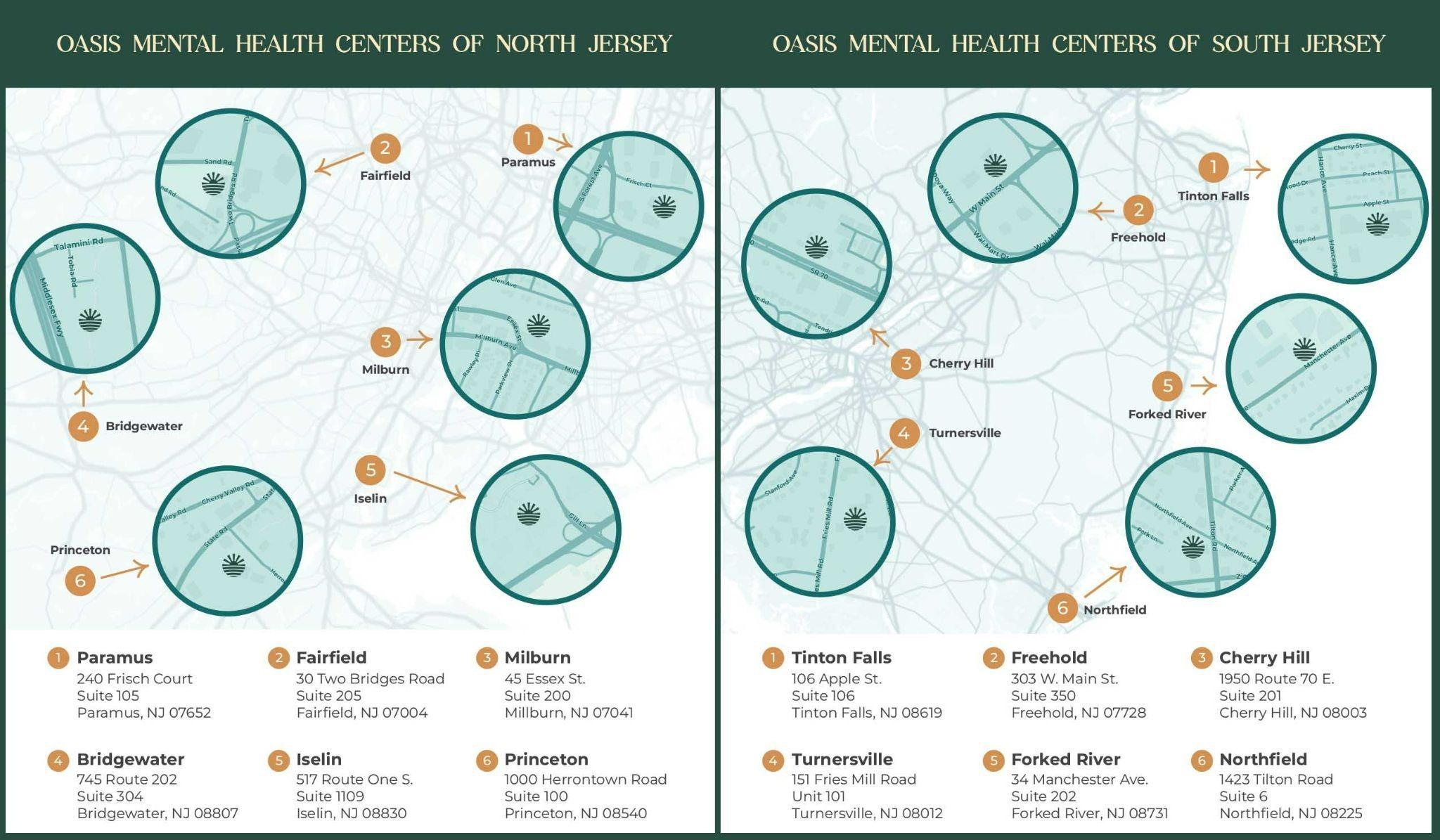
Getting started follows a few clear steps:
- Free consultation: a 10 to 15 minute conversation, by phone or telemedicine, to talk through what you’re experiencing.
- Evaluation: a closer look at your history, symptoms, and any treatments you’ve already tried, to determine the right path forward.
- Insurance verification: our team verifies your coverage and handles prior authorization on your behalf, so that part doesn’t fall on you.
- Treatment begins: once everything’s confirmed, care starts, without you having to manage the process yourself.
But starting treatment is just the beginning of the process, not the end of it.
Healing Takes Time (and a Caring Team)
No one benefits from depression treatment overnight, and progress isn’t always a straight line. Good care means tracking how you’re doing over time, adjusting the plan as needed, and having an actual team, not just one provider, involved in your care. That might include a psychiatric provider, a therapist you continue seeing outside our program, and the clinicians who deliver TMS or Spravato® directly.
Depression can also show up alongside other struggles, substance abuse or substance use disorders, anxiety, chronic stress, or major life transitions. Part of a thorough evaluation is figuring out what else might be part of the picture, since treating depression in isolation, when something else is also going on, rarely leads to lasting progress.
At Oasis, that means regular check-ins throughout your treatment, not just at the start. We track how you’re responding, adjust course when something isn’t working, and stay coordinated with any other providers already involved in your care, so nothing gets lost between appointments.
All of that starts with one thing: you telling us your story. Start that conversation with our team today. We’re here to listen.
Frequently Asked Questions
How do I know if I should seek help from a center for depression, or if things will improve on their own?
If low mood, loss of interest, or changes in sleep and energy have lasted more than two weeks and are getting in the way of daily life, that’s generally a good point to seek support rather than wait it out. You don’t need to hit a crisis point first, earlier support tends to lead to better outcomes.
What will we actually discuss during my first appointment?
We’ll ask about your current symptoms, what you’ve tried before, your general health history, and what a realistic treatment path could look like. This is a conversation, not an exam, and there’s no wrong way to answer.
Does Oasis treat conditions like bipolar disorder or substance use disorders?
We treat major depressive disorder with TMS and Spravato®, and OCD with TMS at our Paramus location. Conditions like bipolar disorder and substance use disorders are screened for during evaluation, since they can affect what treatment is appropriate, but they aren’t conditions we treat directly here.