









If you’re about to start Spravato® treatment, or you’re already partway through it, it’s worth knowing how long it stays in your system and how soon its effects wear off.
That detail matters if you have a drug test coming up. It also matters if you need to know when you’ll feel clear-headed enough to drive, get back to work, or take care of other important stuff.
That way, you’ll know exactly what to expect, and when.
Key Takeaways
- Spravato® (esketamine) has a relatively short half life of about 7 to 12 hours. Esketamine is mostly cleared from blood in 35 to 60 hours (roughly 1.5–2.5 days), though some metabolites can linger a bit longer.
- The acute psychoactive effects of Spravato® wear off within a few hours of administration. Most patients feel alert within two to four hours post-treatment, but monitoring is required for at least two hours post-administration due to potential residual effects. Patients must not engage in activities like driving until the next day after a restful sleep.
- Standard drug tests typically do not include Spravato® or esketamine detection. However, specialized panels can detect it in urine for 2–4 days, in blood for 12–48 hours, in saliva for up to 48 hours, and in hair for up to 90 days.
What Is Spravato® and Why Does “How Long It Stays” Matter?
Spravato® is an FDA approved nasal spray containing esketamine. It comes from the same family as ketamine, but Spravato® is made from a specific form of that same molecule, refined in a way that allows for a lower, more predictable dose. It’s given as a nasal spray under medical supervision.
For treatment-resistant depression, it can be used on its own or alongside an oral antidepressant. For major depressive disorder with suicidal thoughts, it’s always given alongside an oral antidepressant.
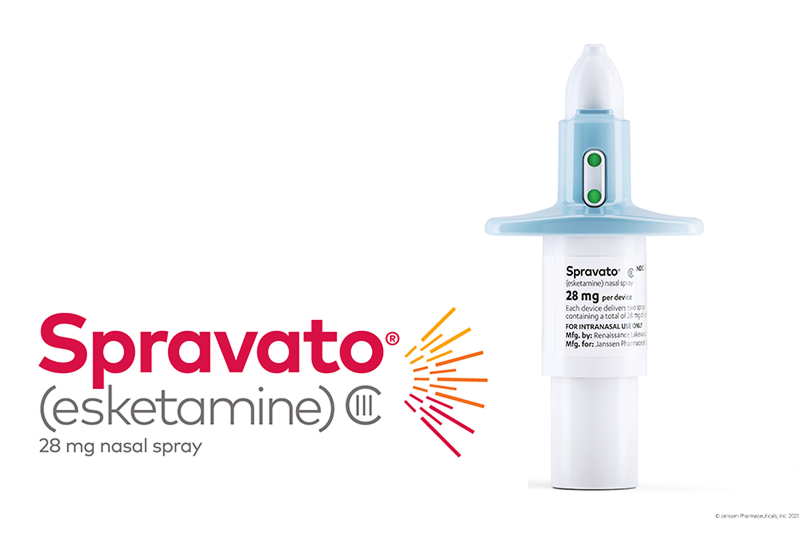
Image courtesy of Johnson & Johnson / Spravato® Treatment Center Communications Toolkit © Johnson & Johnson and its affiliates 2025
Every dose is administered in a certified doctor’s office or clinical setting under direct medical supervision. You never take it home.
Unlike traditional antidepressants like SSRIs or SNRIs, which work slowly by adjusting serotonin levels over weeks, Spravato® works through NMDA receptors and glutamate pathways, producing faster changes in brain circuitry and depressive symptoms. That different mechanism is part of why people want to understand how long does Spravato® last in the body.
People care about this for real, everyday reasons: planning time off work, arranging childcare, knowing when it’s safe to drive, and feeling prepared for workplace drug screening.
How Long Does Spravato® Stay in Your System? (Short, Direct Answer)
Here’s the quick version before we dig into the details:
- Blood levels peak rapidly within 20 to 40 minutes after administration of the Spravato® nasal spray.
- The half life of Spravato® is approximately 7 to 12 hours, meaning the amount of the drug in your blood drops by half during that window.
- It typically takes around five half-lives for a drug to be mostly eliminated from the body. For Spravato®, that works out to roughly 35–60 hours (about 1.5–2.5 days).
- Esketamine breaks down into byproducts, called metabolites, that can linger in urine even after it’s cleared from your blood.
- Complete elimination of Spravato® can take several days depending on individual factors like liver function and other medications.
While the drug clears your blood within a couple of days, its effects on mood can last much longer. Repeated dosing helps build that effect over time, which is why treatment starts with more frequent sessions during the induction phase.
Spravato®’s Half-Life and Timeline in the Body
“Half life” sounds technical, but the concept is simple. If you start with 100 units of a drug in your bloodstream, the half life is the time it takes for that amount to drop to 50. After another half life, you’re down to 25, and so on. After about 4–5 half lives, only a tiny fraction remains.
Esketamine has a half-life of 7 to 12 hours. So after roughly 35–60 hours, most of the Spravato® medication is out of your blood. But there’s a second chapter to the story.
Your liver breaks esketamine down using enzymes called CYP2B6 and CYP3A4, part of a larger family known as cytochrome P450 enzymes. This process converts esketamine into a byproduct called noresketamine.
These metabolites are then filtered by the kidneys and leave through urine over the next several days. That’s why some forms of drug testing can pick up traces even after you feel completely back to normal. More details on this later.
Factors That Affect How Long Spravato® Stays in Your System
The numbers above are averages. Real people are different, and several factors affect how long Spravato® and its metabolites stay in the body:
- Metabolism and genetics: Individual metabolism rates can vary based on genetics and overall health. Faster metabolizers clear the drug sooner.
- Liver function: Liver health affects how long Spravato® stays in your system. Since esketamine is processed in the liver, any impairment slows clearance and can prolong side effects.
- Kidney function: Kidney function affects the elimination of Spravato® metabolites, since they leave the body primarily through urine.
- Age and body composition: Your age and body composition can affect how Spravato® is distributed and eliminated. Older adults may have reduced liver blood flow, slightly slowing metabolism.
- Dosage and schedule: Higher doses of Spravato® take longer to clear from the body. Higher administered doses during induction versus maintenance therapy can also lead to more metabolite accumulation.
- Other medications: Some antidepressants, like paroxetine, fluoxetine, duloxetine, and venlafaxine, can raise esketamine levels in your blood by inhibiting the same liver enzymes that break it down.
- Overall health and co-occurring conditions: Conditions like chronic pain, general health status, and psychological factors can influence the treatment duration of drug presence in your system.
At Oasis, our healthcare providers review your medical history, current medications, and labs when needed to individualize the plan and keep your ongoing treatment as safe and predictable as possible.
How Long Do Spravato®’s Effects Last During and After a Session?
There’s an important difference between how long esketamine stays in your body and how long you actually feel it. The “feeling” part is much shorter than the detection window.
- Many patients start feeling acute effects like dissociation, mild sedation, and altered perception within 10–20 minutes, with peak effects around 40 minutes to 1 hour.
- These initial, intense effects usually fade over 2–4 hours. Most patients feel alert within two to four hours post-treatment, though mild fatigue or fogginess can linger into the rest of the day.
- Because of these short-term effects, patients stay at the clinic for at least 2 hours for monitoring, including blood pressure checks. A trusted person or ride service takes them home, as driving or operating heavy machinery is not advised the day of treatment.
On the brighter side, the “mood” benefits can start within hours to days. Some individuals notice positive changes after their first sessions, and Spravato®’s effects can build over time with consistent treatment across the induction phase. However, individual response is highly variable, which is why at Oasis we talk through what to expect before each treatment session and help you plan your day around these acute effects.
Spravato® and Drug Tests: Will It Show Up?
This is a core worry for many patients, so let’s be direct: standard employment and school drug tests (the routine 5-panel screenings) do not test for ketamine or esketamine, so Spravato®, typically, won’t show up on them.
Expanded or specialized drug testing panels are a different story. These broader panels, sometimes used in workplace, legal, or medical settings, are built to detect ketamine and related compounds, and a documented course of Spravato® treatment can trigger a positive result on one of them.
That result doesn’t mean illicit drug use. When Spravato® is prescribed as a legitimate FDA approved treatment and documented by a healthcare professional, a positive finding should be read in that medical context.
If an expanded panel does return a positive result, a Medical Review Officer, a licensed physician who reviews test results for legitimate medical explanations, can factor in documentation of your prescribed Spravato® treatment before it’s reported.
If you know you have an upcoming drug test, tell your Oasis clinician ahead of time. The team can help with timing, documentation, and communicating with testing entities when appropriate.
Detection Windows by Test Type
Each type of drug test has different strengths and detection timelines for ketamine and esketamine. Here’s a practical breakdown:
Test Type | Typical Detection Window | Notes |
Urine tests | 2–5 days (up to 2 weeks with frequent use) | Esketamine is detectable in urine for 2 to 5 days after use. Metabolites may persist longer with slower metabolism. |
Blood tests | 1–3 days | Blood tests can detect esketamine for 24 to 72 hours. Most effective and accurate within the first 24 hours. |
Saliva tests | 24–48 hours | Saliva tests can detect Spravato® for up to 48 hours. Convenient but short window. |
Hair follicle tests | Up to 90 days or more | Hair tests can detect Spravato® for up to 90 days as drug traces become incorporated into the growing hair shaft. Rare in routine employment screening. |
Test cutoffs, lab technology, and individual biology all shift these windows. Don’t rely on exact numbers. Instead, talk openly with your healthcare provider about any upcoming drug testing so you can plan together.
From here, the details will look a little different for everyone, depending on your dose, your schedule, and how your body responds.
What to Expect as You Move Forward
Everything covered here, half-life, drug test windows, how long a single dose’s effects last, are general ranges. Your actual experience depends on your dose, your metabolism, and how many sessions you’ve had. Most patients find that after the first few sessions, they have a much clearer sense of their own timeline: how they’ll feel that day, when they’re back to normal, and what a test would or wouldn’t catch.
Your care team at Oasis keeps track of your schedule and can talk through timing questions, whether that’s an upcoming drug test, a work shift, or picking your kids up from school, before they become a scramble.
If you’re ready to start Spravato® treatment, start a conversation with us. We’ll walk you through what to expect, from your first evaluation to what a typical week of treatment looks like.
FAQ: Spravato®, Drug Tests, and Daily Life
How soon after treatment is it actually safe to drive?
Not until the next day, after a full night’s sleep, no matter how alert you feel right after your dose. That’s why every patient arranges a ride home from each session. Clinical studies found a few patients still had lingering effects several hours in, which is why the guidance is “wait until the next day” rather than a specific number of hours.
Does body weight, age, or other medications affect how quickly Spravato® clears my system?
Body weight and sex don’t make a meaningful difference, that’s been studied across a wide range of patients. Age and liver function do: older patients and those with liver impairment tend to process it more slowly, so it can stay in their system longer. Your Oasis clinician reviews your health history before starting treatment, since these factors shape your specific timeline.
Can Spravato® be combined with my current antidepressant or therapy?
For treatment-resistant depression, Spravato® can be used on its own or alongside an oral antidepressant, depending on what your prescriber recommends. For major depressive disorder with suicidal thoughts, it’s always used together with an oral antidepressant. Most patients also continue any ongoing psychotherapy, talk therapy like CBT or trauma-focused approaches often supports and helps sustain Spravato®’s effects, so it’s typically one part of a broader treatment plan rather than a replacement for everything else.
Is there a risk of becoming dependent on Spravato®?
Esketamine, the active ingredient in Spravato®, is a Schedule III controlled substance, and FDA studies found its abuse potential is similar to IV ketamine at comparable doses. What lowers the risk in practice is how it’s given: every dose happens at a certified clinical site under direct supervision, you never take it home or control your own dosing, which removes the kind of repeated, escalating use that leads to dependence.