






If standard antidepressants haven’t given you real relief, even after trying more than one, you’ve probably come across esketamine in your research, or you may know it better by its brand name, Spravato®. It works differently than anything you’ve likely tried before, and for a lot of people, that difference matters.
Esketamine is the active ingredient in Spravato®, a nasal spray FDA approved for treatment-resistant depression and for depressive symptoms in adults with major depressive disorder (MDD) who are experiencing suicidal thoughts.
It isn’t a first-line treatment, and it isn’t for everyone, but for people who qualify, it offers a genuinely different path forward.
Key Takeaways
- Esketamine (known by its brand name Spravato®) is an FDA-approved nasal spray for treatment-resistant depression and for major depressive disorder, a serious mental illness, when suicidal thoughts are present.
- Esketamine nasal spray is self-administered under direct medical staff supervision in a clinic setting, with at least two hours of monitoring afterward, and you’ll need someone to drive you home since you can’t drive yourself.
- It works differently than conventional antidepressants by targeting the glutamate system instead of serotonin, norepinephrine, or dopamine.
- In clinical trials, esketamine produced a meaningful reduction in depressive symptoms for people who still felt depressed despite trying at least two other antidepressants, often within hours rather than the weeks conventional antidepressants require.
- Common side effects include temporary changes in perception, such as feeling disconnected from your surroundings, along with dizziness, nausea, and a short-lived rise in blood pressure.
What Is Esketamine?
Esketamine is derived from ketamine, an anesthetic medication that has been used safely in hospitals for decades. Esketamine is a more potent, refined part of the ketamine molecule, which is part of why it can be given at a lower dose while still producing a strong effect.
It’s classified as a Schedule III controlled substance (CIII), meaning it carries some potential for abuse and psychological dependence, similar to other controlled prescription medications. That’s one reason esketamine treatment is never something you take home. It’s given under direct medical staff supervision, in a clinic setting, every single time.
How Esketamine Works in the Brain to Treat Depression
Conventional antidepressants, the ones most people try first, work by increasing levels of naturally occurring chemicals like serotonin, norepinephrine, and dopamine. These are neurotransmitters, chemical messengers that relay signals between brain cells, and the theory behind traditional antidepressants is that having more of them improves communication between brain cells and lifts mood over time.
Esketamine works through a different mechanism entirely. Rather than targeting serotonin, norepinephrine, or dopamine, it affects the glutamate system, the most abundant chemical messenger in the brain.
This different mechanism is part of why esketamine can provide relief for people who haven’t responded to other antidepressants, and it’s also part of why the effect can show up much faster, sometimes within hours, rather than the four to eight weeks it typically takes conventional antidepressants to build up.
Who Is Esketamine For?
Esketamine isn’t approved as a first treatment for depression. It’s approved for two specific situations:
- Treatment-resistant depression (TRD): depression that hasn’t improved enough after trying at least two different antidepressant medications, from different drug classes, at adequate doses, for an adequate length of time. This affects roughly 1 in 3 people with major depressive disorder, more common than most people realize.
- Major depressive disorder (MDD) with suicidal thoughts or actions: in this case, esketamine is always used together with an oral antidepressant, not in place of one.
It’s also worth being clear about something here: esketamine is not currently approved or proven to prevent suicide or directly reduce suicidal thoughts on its own. It’s approved to treat depressive symptoms in people experiencing suicidal thoughts, alongside an oral antidepressant and appropriate clinical care, not as a stand-alone crisis intervention, and it’s never a substitute for emergency care or hospitalization when that’s what’s needed.
A doctor determines whether esketamine is appropriate based on your treatment history, current symptoms, and overall health, not from a single conversation, but from a full evaluation.
What to Expect During Esketamine Treatment
Esketamine treatment happens entirely on an outpatient basis, meaning you don’t stay overnight.
Here’s what a typical treatment day looks like:
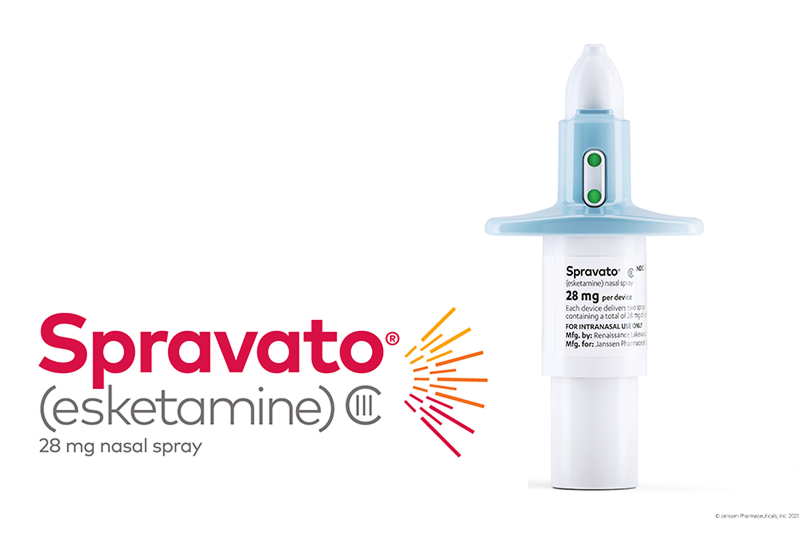
- You self-administer the nasal spray, using two to three devices depending on your prescribed dose. Each device delivers one spray into each nostril. You use one device, wait five minutes, then use the next, repeating until your full dose is complete, all under the direct supervision of clinical staff.
- You remain in the clinic for at least two hours afterward, while staff monitors your blood pressure and checks for side effects like sedation or feeling disconnected from yourself or your surroundings.
- You cannot drive yourself home. You’ll need a caregiver or family member to take you, since esketamine can affect judgment and alertness for the rest of the day.
Before your appointment, there are a few things to keep in mind: no food for at least two hours beforehand, no liquids in the 30 minutes before your dose, and if you use a nasal corticosteroid or decongestant, take it at least one hour before your esketamine dose.
Treatment Schedule
Esketamine treatment moves through three phases, with sessions becoming less frequent at each stage:
- Induction: for the first four weeks, you’ll come in twice a week.
- Transition: after that, sessions drop to once a week for a stretch of several weeks.
- Maintenance: from there, sessions space out further, typically once every one to two weeks, and for some patients, every four weeks once things have stabilized.
The pace isn’t fixed. Your provider adjusts it based on how you’re responding, not a set calendar, so this timeline can look different from one patient to the next. At Oasis, we’d rather get the pace right than rush you through it.
Esketamine vs. Traditional Antidepressants
Esketamine (Spravato®) | Traditional Antidepressants | |
Mechanism | Works on the glutamate system | Increases serotonin, norepinephrine, or dopamine |
Time to relief | Often within hours to days | Typically 4 to 8 weeks |
How it’s taken | Nasal spray, administered in a clinic | Pill, taken at home |
Supervision required | Yes, at least 2 hours per dose | No |
Who it’s for | Treatment-resistant depression or MDD with suicidal thoughts, alongside an oral antidepressant | Often tried first, for a broader range of depression |
Neither approach is inherently better. Conventional antidepressants remain the appropriate first step for most people with depression. Esketamine exists for the specific group of people who’ve tried that path and still need something more.
Safety: Potential Side Effects and Who Shouldn’t Take Esketamine
The most common side effects of esketamine therapy happen shortly after the dose and typically resolve the same day. They include:
- Feeling disconnected from yourself, your thoughts, or your surroundings (dissociation)
- Dizziness or a spinning sensation
- Nausea
- Drowsiness
- Increased blood pressure
- Headache
- Numbness
- Anxiety
Increased blood pressure deserves its own mention, since it’s common enough that it’s checked before every dose and monitored for at least two hours afterward, as it can last for several hours. If you have high blood pressure or a history of heart problems, your care team needs to know before you start, not because it automatically rules you out, but because it changes how closely you’ll be monitored.
Some conditions are absolute contraindications, meaning esketamine should not be used at all if they apply to you:
- Aneurysmal vascular disease (aneurysms in the brain, chest, abdominal aorta, arms, or legs)
- Arteriovenous malformation, an abnormal connection between veins and arteries
- A history of bleeding in the brain (intracerebral hemorrhage)
- An allergy to esketamine or ketamine
This matters because esketamine’s temporary effect on blood pressure could be dangerous if you have any of these conditions. A thorough medical history is part of every evaluation for exactly this reason.
Because of the risks for sedation, dissociation, and potential misuse, esketamine is only available through a restricted FDA program, called REMS (Risk Evaluation and Mitigation Strategy). This means it can only be administered at certified clinics with direct medical supervision.
Cost and Insurance Coverage
Spravato® is covered by all major New Jersey insurance plans when prior authorization criteria are met, so for most patients, cost comes down to plan design rather than paying entirely out of pocket.
With Insurance
With insurance, most patients pay up to $250 per session, depending on plan design. The exact amount comes down to your deductible, copay, and coinsurance, what you owe annually before coverage kicks in, your fixed cost per visit, and the percentage you’re responsible for afterward. Because induction happens twice a week, many patients reach their deductible faster than usual, which can lower per-visit costs for the rest of the year.
Without Insurance
Without insurance, costs break down like this:
- Cost per dose: roughly $590 to $885, depending on strength (56 mg or 84 mg)
- Cost per full session, including required monitoring: typically $1,000 to $1,500
- First month of treatment: $4,700 or more, sometimes exceeding $7,000, due to twice-weekly induction sessions
For eligible patients with commercial insurance, a manufacturer savings program (called the Spravato® withMe Savings Program) can also help bring medication costs down to as little as $10 per treatment, and patient assistance options or payment plans are available for anyone who doesn’t qualify. Our staff walks you through your specific coverage and gives you a real cost estimate before your first dose, so you’re never guessing.
Esketamine Treatment at Oasis: What Sets Our Care Apart
Oasis is a REMS-certified provider, which means every single dose is given under direct clinical supervision, exactly as this treatment is meant to work, so you’re never navigating it alone in the room.
Before we ever talk about a treatment plan, we want to understand you: what you’ve been through, what you’ve already tried, what’s helped and what hasn’t, and where you are right now. That conversation comes first, always. From there, we determine together, not for you, whether esketamine is genuinely the right next step.
We also know the practical side of this weighs on people, so our team handles insurance verification and prior authorization on your behalf, one less thing you have to carry while you’re already carrying a lot.
Start a conversation with Oasis to find out if esketamine could be part of your care.
Frequently Asked Questions
Do I have to stop taking my current antidepressant to start esketamine?
Not always. For treatment-resistant depression, esketamine can be used either on its own or alongside an oral antidepressant, depending on what your doctor recommends. For major depressive disorder with suicidal ideation specifically, it’s always used together with an oral antidepressant, never in place of one.
What happens if esketamine doesn’t work for me?
Not everyone responds the same way. If esketamine doesn’t provide enough relief, your care team will talk through other options with you, adjusting your current plan, exploring a different treatment approach entirely, or a referral for a different level of care, based on your specific situation.
Can I continue therapy while receiving esketamine treatment?
Yes, and many patients do. Esketamine addresses depression through a different mechanism than talk therapy, so continuing therapy alongside treatment is common and often complements the medication rather than competing with it.
How long will I need to stay on esketamine treatment overall?
There’s no single fixed endpoint. Some patients complete the induction and transition phases and then stop, others continue occasional maintenance sessions for months if symptoms respond well to that ongoing support. Your provider reassesses this with you as treatment progresses rather than committing you to a fixed timeline upfront.