









Before trying something new, it’s natural to want to know not just whether it works, but how.
Spravato® is a newer depression treatment that works differently from the medications you may have already tried, and many patients report symptom relief faster than they expected.
This guide walks through how Spravato® works in the brain, what a treatment session actually feels like, and how to decide if it might be right for you.
Key Takeaways
- Spravato® is an FDA-approved nasal spray that targets the brain’s glutamate system and N methyl D aspartate (NMDA) receptors (a brain pathway linked to mood and thinking), helping brain cells form new connections involved in mood regulation.
- Unlike traditional antidepressants that can take several weeks, Spravato® can begin working within hours or days, providing rapid relief of depressive symptoms for people with treatment resistant depression or major depressive disorder (MDD) with acute suicidal ideation.
- Every Spravato® session takes place in a calm, supervised clinic setting where our team monitors you for about two hours and stays with you the entire time.
- Spravato® is not typically a first treatment. It is an option when other treatments and conventional medications have not provided sufficient relief, or when suicidal thoughts are present.
What Is Spravato® (Esketamine)?
Spravato® is the brand name for esketamine, a prescription nasal spray approved by the Food and Drug Administration.
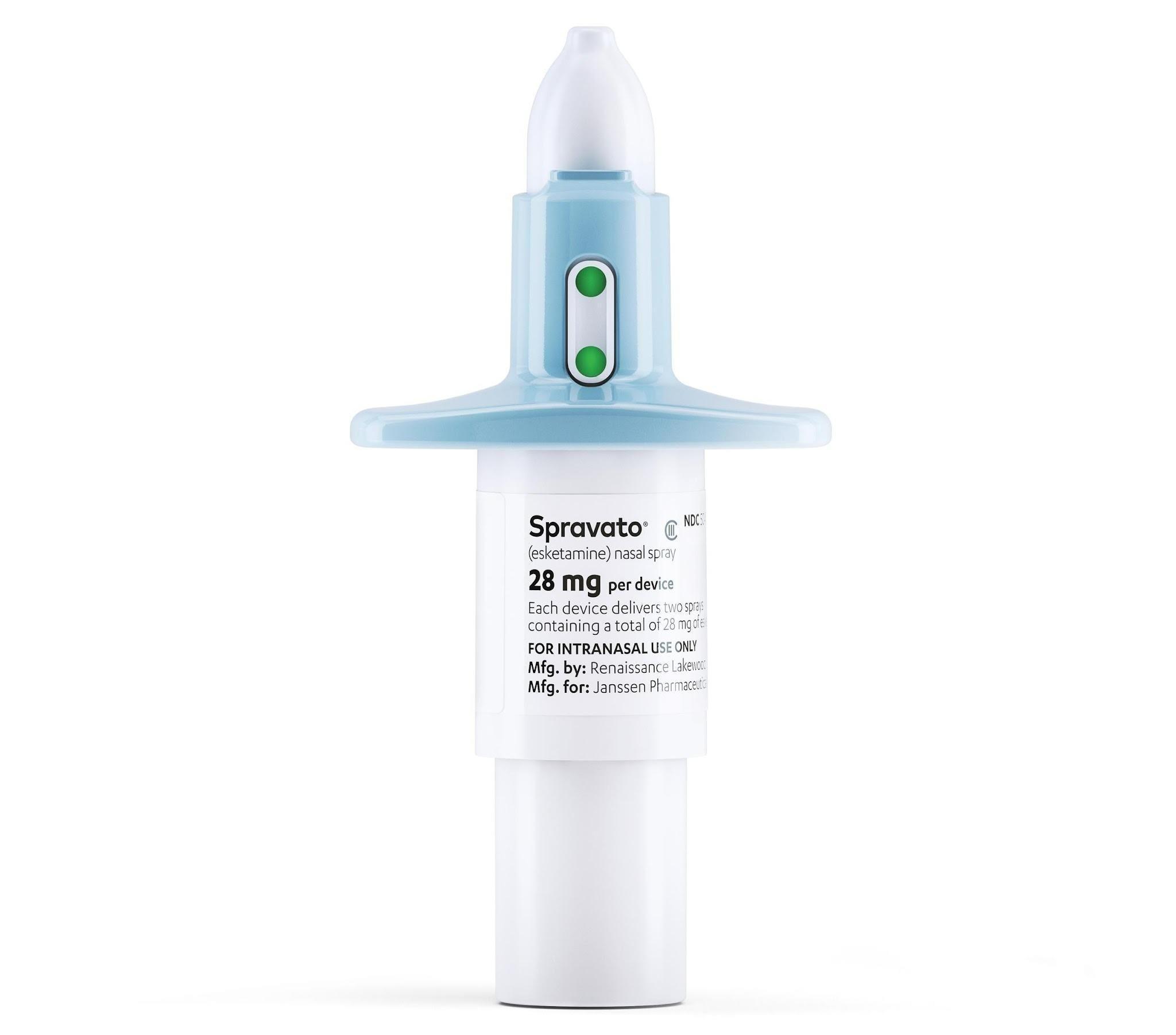
Image courtesy of Johnson & Johnson / Spravato® Treatment Center Communications Toolkit © Johnson & Johnson and its affiliates 2025
Esketamine was FDA-approved in March 2019 for treatment resistant depression (TRD), with the indication later expanding to cover major depression with suicidal ideation.
It comes from the same family as ketamine, but Spravato® is made from a specific form of that same molecule, refined in a way that allows for a lower, more predictable dose. It’s given as a nasal spray under medical supervision.
How it’s used depends on your diagnosis: for treatment resistant depression, the FDA approved Spravato® as a standalone option in January 2025, so it can now be used on its own. For major depressive disorder with acute suicidal ideation, it’s still given alongside an oral antidepressant.
Now, let’s understand what Spravato® actually does inside your brain.
How Does Spravato® Work in the Brain?
To understand what makes Spravato® different, it helps to start with how most depression medications work in the first place.
Traditional antidepressants like SSRIs (Selective Serotonin Reuptake Inhibitors) and SNRIs (Serotonin and Norepinephrine Reuptake Inhibitors) mainly work on serotonin, norepinephrine, and dopamine, three brain chemicals tied to mood. These medications raise those chemical levels fairly quickly, but easing depression symptoms depends on the brain’s ability to slowly rewire itself, which is why it can take several weeks to feel different.
Spravato® works on a different brain chemical entirely: glutamate, the brain’s most common messenger chemical. Here’s a simplified, step-by-step look at what happens:
- Spravato® briefly blocks a receptor called NMDA (short for N-methyl-D-aspartate, just the name of a specific docking site on brain cells) on certain nerve cells.
- Blocking that receptor causes a surge of glutamate, which briefly increases activity and communication between brain cells.
- That extra glutamate activates a different receptor called AMPA, which triggers the release of a protein called BDNF (brain-derived neurotrophic factor), a substance that helps brain cells grow and form new connections.
- Those new connections are part of a broader process called neuroplasticity, your brain’s ability to reorganize itself and build new pathways.
In simpler terms, Spravato® helps your brain’s ‘stuck’ pathways reset and reconnect. Clinical studies show some people feel lighter or less overwhelmed within four to twenty-four hours, though responses vary.
However, that quick change often comes bundled with another effect worth understanding: dissociation.
How Dissociation Fits Into How Spravato® Works
If the idea of feeling “weird” or “out of it” makes you nervous, that’s completely understandable.
Let’s walk you through what dissociation actually means during a Spravato® session instead of leaving it to your imagination.
Dissociation is a temporary, dreamlike sense of being slightly detached from your body, thoughts, or surroundings, though you stay aware the entire time that you’re in a treatment center receiving care. Patients find the experience is usually mild to moderate, often describing it as feeling floaty, noticing that time seems to move differently, or sensing that colors look a bit brighter.
That sensation follows a fairly predictable timeline: it typically starts five to ten minutes after dosing, peaks around the forty-minute mark, and fades over the following thirty to ninety minutes. Medically, this is categorized as a known side effect of Spravato®, but it isn’t just something to get through. Researchers believe it may also loosen rigid negative thought loops, letting the glutamate-driven changes underway create healthier patterns in mood regulation.
Through all of it, our team at Oasis stays present and checks in frequently, so you feel safe and grounded the whole way through.
Who Is Spravato® For? (And Who It’s Not For)
Not everyone with major depressive disorder (MDD) needs Spravato®, and careful evaluation protects patient safety. Here is a quick overview of who may benefit and who may need a different path.
Good candidates generally include:
- Adults with treatment resistant depression who have tried at least two traditional antidepressants from different classes without sufficient relief
- Adults experiencing a major depressive episode with suicidal thoughts or behaviors, where rapid relief can be life-saving
Spravato® may not be appropriate if you have:
- Uncontrolled hypertension or high blood pressure
- A history of aneurysm, stroke, or heart conditions (including risk factors like chest pain)
- Active substance use disorder, including misuse of street drugs
- Pregnancy or are breast-feeding
- A history of psychosis or certain medical conditions that increase risk
At Oasis Mental Health Centers, our team completes a thorough medical and psychiatric assessment, including your full medical history and medication list, before recommending Spravato® treatment. We encourage you not to self-exclude.
Instead, talk openly with your healthcare provider so we can weigh risk factors and benefits together.
What Happens During a Spravato® Session at Oasis?
A lot of the anxiety around starting Spravato® comes from not knowing what the actual session looks like.
Here’s a step-by-step look at what to expect.
- Arrival and check-in: We take your vitals, including blood pressure, do a brief mood and safety check, and answer any last-minute questions.
- Supervised administration: You self-administer the esketamine nasal spray into each nostril under our clinician’s guidance. You’ll likely administer two to three doses during each session, spaced about five minutes apart, based on your prescribed dose.
- The environment: A quiet, softly lit room with a comfortable recliner, blankets, eye masks, and calming music if you like.
- Monitoring: Staff check blood pressure, heart rate, and your level of awareness periodically. You are monitored for about two hours after administration, and our team stays nearby throughout.
- Discharge: You cannot drive yourself home after a Spravato® session. Someone must take you home, and you should avoid operating any machinery or making important decisions until the next day, after a full night of sleep.
You are also encouraged to keep yourself hydrated for the remainder of the day after your dose is administered.
Treatment Schedule
Spravato® treatment happens in stages rather than all at once.
- Induction: for the first four weeks, you’ll come in twice a week.
- Transition: after that, sessions drop to once a week for a stretch of several weeks.
- Maintenance: from there, sessions space out further, typically once every one to two weeks, and for some patients, every four weeks once things have stabilized.
However, this timeline isn’t the same for everyone. How you respond shapes the pace, and it’s your healthcare provider, not a preset calendar, who decides when you’re ready to move into the next phase.
At Oasis, we’d rather take that decision slowly and get it right than rush you into a schedule that doesn’t fit where you actually are.
What Spravato® Feels Like for Most People
“How will I feel?” is another common and completely understandable question we hear at Oasis.
Here is what many patients describe:
- Feeling floaty or heavy in the body
- Mild changes in depth perception or sound
- Slowed or drifting thoughts, emotional distance from worries
- A sense of calm detachment that fades gradually
Most people remain aware, can respond to staff, and can communicate discomfort at any time. Dissociative effects occur in a majority of patients but are usually mild to moderate and often feel less intense after the first one to two treatments.
Some people feel calmer before they leave; others feel tired and notice mood changes later that day or the next morning. Whatever you experience, our team tracks it closely and adjusts the treatment plan as needed.
Beyond the experience itself, it’s worth weighing the benefits against the risks.
Benefits and Risks: Balancing Hope with Safety
It is natural to carry both hope and fear when considering Spravato®. Both feelings are reasonable, and we want to be honest about what the evidence shows.
Key benefits:
- Rapid relief of depressive symptoms, sometimes within a few hours
- Improved mood, motivation, and functioning
- Reduced suicidal thoughts in patients experiencing acute suicidal ideation
- A different mechanism that can treat adults who have not responded to other antidepressants
Common side effects:
Side Effect | Frequency | Typical Course |
Dissociation | Very common | Peaks ~40 minutes, resolves within 2 hours |
Dizziness | Very common | Similar timing pattern |
Nausea | Common | Usually mild |
Increased blood pressure | Common | Monitored throughout visit |
Headache | Common | May persist after visit |
Altered taste, nasal numbness | Less Common | Temporary |
For most patients, esketamine’s side effects hit hardest during the first couple of sessions and ease up from there. Serious complications are rare, but that small risk is exactly why every Spravato® session at Oasis takes place under direct clinical supervision.
Serious but less common risks:
- Significant blood pressure spikes (managed on-site with rest, positioning, or medication if needed)
- Respiratory arrest or breathing problems (extremely rare)
- Severe dissociation requiring extended monitoring
- New or sudden changes in behavior or mood
Because of these effects, Spravato® is tightly regulated under REMS (Risk Evaluation and Mitigation Strategy). That means it can only be given in certified clinics with mandatory post-dose monitoring, and this structure exists to ensure patient safety.
At Oasis, decisions about starting, continuing, or stopping Spravato® are always made collaboratively, based on how you feel and what matters most in your life.
Taking the Next Step with Spravato® at Oasis
It takes real courage to keep looking for help when depression has already taken so much from you.
If conventional medications and traditional treatments (like pills and therapy) have not provided the relief you need, we invite you to have a conversation with us.
Our initial conversation is focused entirely on understanding you, reviewing prior treatments, and discussing risks and benefits honestly.
If you are ready to take the next step toward lasting relief from depression, contact us today and let’s find out if Spravato® is the right fit for you.
Frequently Asked Questions
How soon will I know if Spravato® is working for me?
Some patients notice shifts in mood, anxiety, or suicidal thoughts within the first one to two treatment sessions, sometimes within twenty-four hours. More often, meaningful change becomes clearer over the first four to eight treatments as sleep, energy, and motivation begin to improve. At each visit, our team checks in about your symptoms and daily functioning to decide together whether to continue, adjust, or stop Spravato® treatment.
Will I have to stay on Spravato® forever if it helps?
Long-term use is not required for everyone. Many people complete an induction and maintenance phase, then gradually taper as their depression remains stable. How long you stay on Spravato® depends on relapse history, prior depressive episodes, and your preference. Any changes are planned carefully with support from our team and other parts of your treatment plan, including therapy, lifestyle adjustments, and other medications.
Can I keep taking my current antidepressant or other medications with Spravato®?
Depending on your diagnosis, Spravato® can be used on its own or alongside an oral antidepressant, though it’s often paired with one early in treatment. However, certain medications for blood pressure, sedatives, or substances like alcohol require special caution or timing adjustments. Share your full, accurate medication list, including supplements and over-the-counter drugs, so our clinicians can keep your plan safe.
Is Spravato® addictive or easy to misuse?
Esketamine is related to ketamine, which can be misused in unsupervised settings. That is exactly why Spravato® is tightly regulated. Patients never take Spravato® home; every dose is given in the clinic under supervised administration, with tracking of response and side effects. For most people using Spravato® as prescribed for depression treatment, the risk of developing addiction is low, but careful screening is part of our process at Oasis.