

If you’re reading this, you’ve probably already looked up TMS once or twice, liked what you saw, and then stopped and asked yourself: does it hurt?
It’s a fair thing to wonder. “Magnetic stimulation to the brain” sounds like something out of a sci-fi movie, and when you’re already worn down by what you’re going through, the last thing you want is to sign up for something painful.
TMS isn’t only for depression, either. It’s FDA-cleared for major depression (including depression with anxiety symptoms), OCD, and helping people quit smoking. Clinicians and researchers are also exploring it for PTSD, ADHD, alcohol use, and anhedonia, that flat, can’t-enjoy-anything feeling that can hang on long after other symptoms ease. Whatever brought you here, the basics in the chair are the same, so this guide is for you, too.
So here’s the short answer up front. Most people describe TMS as a tapping or knocking feeling on the head. It can be uncomfortable at first, especially in the first week, but it isn’t painful for most people, and the sensation usually fades into the background as treatment goes on. Below is what your first session actually looks like, start to finish.
Before you even sit down for Transcranial Magnetic Stimulation (TMS)
There’s not much prep involved. Before treatment starts, your care team goes over your health history and screens for things like metal implants in or near the head, since TMS uses a magnetic field.
On the day itself, wear whatever’s comfortable. Leave the earrings, hair clips, and metal headbands at home, and you’ll be asked to set aside your phone and keys during the session.
You don’t need to fast. You won’t be sedated. You’re awake and alert the entire time, which means you can drive yourself there and then go on with your day.
The first visit is a little different
Your first session includes a step called mapping. Every brain is a bit different, so before treatment begins, your clinician needs to find the right spot on your head and the right strength for you.
To do that, they place the TMS coil over the area of the brain that controls hand movement and send a few pulses. When they hit the right spot, your thumb or fingers will twitch on their own. It feels strange the first time you see it happen, and plenty of people laugh. That little twitch is actually a good sign: it tells your clinician they’ve found your baseline, and they use it to set your treatment level and locate the area they’ll be treating.
Because of this step, the first appointment runs longer than the ones that follow. After that, sessions get shorter and more routine.
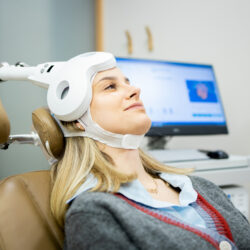
You’ll sit in a reclined chair, a lot like a dentist’s chair but more comfortable. The coil rests gently against your head, or for some conditions, sits inside a padded cap. Then the pulses start.
Here’s how most people describe it:
- A tapping on your scalp. Picture someone flicking a finger against the same spot on your head in quick, steady bursts. That’s the closest comparison. It’s rhythmic, and it comes in short trains with breaks in between.
- A clicking sound. The machine makes a loud, repetitive click with each pulse. You’ll be given earplugs, and after a few minutes most people stop noticing it.
- Small muscle twitches. Sometimes the pulses make the muscles near the coil twitch, like your eyebrow, the side of your face, or your jaw. It’s odd, not harmful, and it stops the second the pulses do.
If the tapping feels like too much, say so. Your technician can adjust things to make you more comfortable, and they’d much rather you speak up than grit your teeth through it.
What you won’t feel: no shock, no burning, no electricity running through you. You stay fully awake, and you can talk, watch something, or just close your eyes and let the time pass. Depending on the protocol your doctor uses, a session can last anywhere from a few minutes to around 40.
Right after the session
When it’s over, you get up and walk out. No recovery room, no grogginess. Most people head straight back to work, pick up their kids, or run errands.
The most common side effects are a mild headache or some tenderness on the scalp where the coil sat. These usually show up in the first week and are easy to manage. Your care team can tell you what’s okay to take if your head is sore afterward. More serious side effects, like seizures, are rare, and your team will walk you through the full picture before you start.
If something feels off after a session, tell your care team. That’s what they’re there for.
Does TMS have lasting side effects?
Yes, and this is the part people wish they’d known going in. The first few sessions are the most noticeable because everything is new: the sound, the tapping, the twitch in your face. By the second week, your scalp gets used to it, and for a lot of patients the whole thing becomes background noise. When treatment helps, a major depressive episode can interfere less with daily life and work, relationships, and routines in everyday life.
Treatment usually runs five days a week over several weeks, so it settles into a routine quickly. For major depressive disorder, psychological treatments are typically the first treatments, and an effective plan may combine TMS with psychotherapy, antidepressant medicines such as selective serotonin reuptake inhibitors (SSRIs), or other treatments chosen with mental health professionals. Psychotherapy can help identify and change negative thought patterns, while antidepressants help adjust brain chemistry in moderate to severe cases and are not usually needed for mild symptoms. Some patients catch up on a show. Others use it as the one quiet stretch in their day where nobody needs anything from them. Support outside the clinic matters too: social support, regular physical activity, nutrition, mindfulness, and a consistent sleep schedule can improve mood and overall mental health, which is also closely tied to physical health because chronic physical illnesses can contribute to experiencing depression, while prolonged isolation can worsen depressive symptoms. Risk factors also include brain chemistry, traumatic events, and stressful events such as trauma or loss, all of which can increase the likelihood that someone may develop depression. Prevention programmes can help prevent depression, and exercise can be especially useful for older adults. When PTSD is part of the picture, post traumatic stress disorder may follow a traumatic event such as a natural disaster, and common reactions can include anxiety, sadness, sleep problems, and trouble concentrating. Most people recover over time, but some develop PTSD when symptoms persist and interfere with daily life. Research is also aimed at improving effective treatment and developing effective medications for trauma survivors. Cognitive Behavioral Therapy can be helpful, and many people with PTSD also have co-occurring depression.
The hardest part is usually the first call
For most people, the fear of TMS ends up being bigger than the tapping itself. If you’ve been putting off treatment because you weren’t sure what you’d be walking into, now you know: a comfortable chair, some clicking, a tap on the head, and then you go home. Depression is more than ordinary mood changes, and its primary indicators are persistent low mood and loss of interest; a depressed mood can feel sad, irritable, or empty, and symptoms that last most of the day for at least two weeks are worth discussing with a healthcare provider. Genetics and family history can raise risk, but they are not the sole cause and do not mean someone will definitely develop it.
At Oasis, we’ll walk you through every step before your first session and answer whatever questions you have, including the ones you feel silly asking. We can also check your insurance for free. Only about one third of people with depression receive treatment, which is one reason to reach out early. Depression is about 1.5 times more common in women than men. If you’re in significant distress, worried about self harm, or need immediate support, call or text the 988 Suicide & Crisis Lifeline in the U.S. right away as an immediate crisis resource. If you’d like to talk through whether TMS is right for you, reach out and schedule a free consultation. A consultation can help review treatment options for clinical depression or major depressive disorder with health care providers and clarify whether TMS or another approach is the better fit, especially if bipolar disorder or other mental disorders are a concern.
Results may vary. Individual results are not guaranteed.