


You’re most of the way through TMS. The mornings had started to feel a little less like wading through wet concrete. Then, somewhere in the last stretch of sessions, the heaviness creeps back in and a quiet voice says, See? It didn’t work.
If that’s where you are right now, take a breath. The TMS dip is the temporary drop in mood or energy some people feel near the end of Transcranial Magnetic Stimulation treatment, and it does not mean the treatment failed. Patients in TMS, people considering it for depression, and the family members or care teams supporting them often need that reminder, because a late setback can feel bigger than it is. What follows explains what the dip is and is not, why it can happen, how to get through it, when to reach out for urgent help, and why many people still benefit from staying the course.
What the dip is in major depressive disorder (and what it isn’t)
The dip is a temporary slide in mood or energy that some patients notice in the later weeks of TMS, often right around the time sessions start to taper. For you it might look like:
- Feeling flat or tearful again after a run of better days
- Sleep getting a little off
- Less get-up-and-go than you had last week
- Being shorter with people, or feeling on edge
- Wondering whether any of this is actually working
What it isn’t is proof that you’re back at square one. Progress with TMS rarely moves in a straight line. It’s less like climbing stairs and more like a hiking trail, where you can drop into a valley and still be standing higher than where you started.
And not everyone goes through it. Plenty of patients finish their sessions without noticing anything like this. If you do hit it, you’re in good company.
Why depression symptoms happen
There’s no single agreed-upon cause, and it can be different from one person to the next. A few things your care team will often point to:
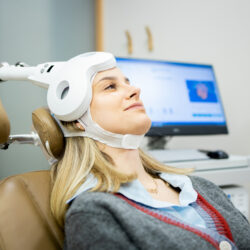
- Your brain is still adjusting. [Transcranial magnetic stimulation TMS] uses magnetic fields and magnetic pulses to stimulate nerve cells in the brain involved in mood; when an [electromagnetic coil] or [magnetic coil] is placed against the scalp to deliver [repeated magnetic pulses], it’s [called repetitive tms], or [repetitive transcranial magnetic stimulation]. For depression, treatment usually targets the dorsolateral prefrontal cortex. Change like that can feel bumpy before it settles. [Repetitive tms] can produce gradual neuroplastic adaptation as the brain reorganizes its pathways during treatment. The dip can be a sign the brain is responding to the stimulation, not proof the treatment has failed. [Unlike electroconvulsive therapy], this treatment does not require anesthesia or sedation and does not cause seizures as part of treatment. [Unlike vagus nerve stimulation] or [deep brain stimulation], it is noninvasive and does not require surgery or implanted electrodes.
- The finish line itself. You’ve built a routine around these sessions. “What happens when I stop coming in?” is a heavy question to carry, and that worry can show up as a low week.
- Life doesn’t pause for treatment. A stressful deadline, a bad night’s sleep, a hard conversation with someone you love. When you’re watching your mood this closely, you feel every bump.
- You’ve had better days to compare to. After a few lighter mornings, an ordinary off day can feel like a crash.
8 ways to get through the dip
- Keep every appointment. When you feel low, skipping a session can feel reasonable. Don’t. Showing up consistently is a big part of how TMS does its work, and, because repetitive TMS is usually considered after other depression treatments such as medication or talk therapy have not helped enough, the days you least want to come in still count. Patients are encouraged to stay with treatment through the dip so the brain’s rewiring process can continue. Most treatment sessions happen five times a week for 4 to 6 weeks, often about 30 sessions total, and each visit usually lasts 30 to 60 minutes.
- Tell your technician or doctor. Say it out loud at your next session: “I’ve been feeling worse this week.” They’ve seen this before, and knowing helps them keep an eye on you and decide whether anything about your plan should change.
- Track the week, not the moment. Each night, give your mood a quick number from 1 to 10. A single bad evening can convince you nothing’s working. Seven days of numbers usually tell a more honest story.
- Guard your sleep. Same bedtime, same wake-up time, phone out of reach. A couple of rough nights can drag mood down on their own, and sleep is one of the few levers you can pull directly.
- Shrink the to-do list on purpose. This isn’t the week to overhaul your life. Pick the smallest version of what matters (a ten-minute walk, one load of laundry, a real lunch) and call that a win.
- Let one person in. You don’t need a big talk. A text that says “Rough week, could use a call” is enough. Carrying it quietly makes it heavier.
- Don’t grade your treatment by one hard stretch. TMS can treat depression, but for some patients, improvement keeps building in the weeks after their final session, so one hard stretch is not the moment to decide how it went. Give the full course the chance to land before you decide how it went. About 60% of people with treatment resistant depression respond to tms therapy, and more than half of responders remain in remission after six months.
- Plan for after. Ask your care team what follow-up looks like once your sessions end, including whether maintenance sessions make sense for you. Some people also continue talk therapy or other depression treatments during or after TMS under their psychiatrist’s guidance. The first appointment usually includes mapping your motor threshold to set treatment intensity, which helps explain how the plan is structured. It also helps to know repetitive TMS does not require anesthesia or sedation and avoids the systemic drug side effects commonly associated with antidepressants. Knowing there’s a plan takes a lot of the fear out of the finish line.
When not to wait it out and consider other treatments
A dip rises and falls. Some things shouldn’t wait for your next appointment. Call your Oasis care team or your doctor the same day if you notice:
- Your mood getting steadily worse over several days instead of going up and down
- Feeling unusually wired, with racing thoughts and barely needing sleep
- Any new physical symptom that worries you
- suicidal thoughts or feeling like you may hurt yourself
During a tms session, the tms coil rests against your scalp, and most side effects are mild and usually ease as your body adapts; about 50% of patients report headaches afterward, about one-third notice painful scalp sensations where the coil sits, and some have brief muscle contractions or twitching during treatment. Rare effects can include transient confusion, and while seizure risk is low at about 0.1%, your team will review risk factors such as a seizure disorder or certain medicines, as well as psychological factors like anxiety, so contact them promptly about anything concerning. Screening should also cover implanted devices or metal near the head, including deep brain stimulators, because these can make TMS unsafe or inappropriate for some people.
Electroconvulsive therapy can be an effective treatment for severe depression in some urgent or high-severity cases, and the right choice depends on symptoms and clinical judgment. If you’re having thoughts of hurting yourself or ending your life, call or text 988 to reach the Suicide & Crisis Lifeline, any time of day. In an emergency, call 911 or go to your nearest emergency room.
You’ve come this far for a reason in your mental health journey
Showing up for a session nearly every weekday, week after week, while depression kept telling you not to bother, takes real effort. One rough patch near the end doesn’t erase that. Keep coming in, keep talking to your team, and let the rest of your treatment do its work.
If you’ve got questions about where you are in your course, bring them to your next session or give us a call. We’d much rather hear from you than have you sit with it alone.
And if you’re reading this because you’re still deciding whether TMS is right for you, it’s free to find out, especially if depression treatments like medication or talk therapy haven’t worked well enough. Transcranial magnetic stimulation is a noninvasive tms treatment that uses magnetic pulses from a coil placed against the scalp, and it’s FDA approved for major depression, including some cases of severe depression, obsessive compulsive disorder, and migraines. It may also help people stop smoking when other treatments haven’t worked and is being researched for epilepsy. We’ll check your insurance and walk you through what to expect, start to finish. People can develop depression for many reasons, and while you can’t always prevent depression, regular sleep, stress management, and self-care may help lower the risk. If you’re exploring TMS for adolescent depression, parents are always welcome to ask questions.
Results may vary. Individual results are not guaranteed.